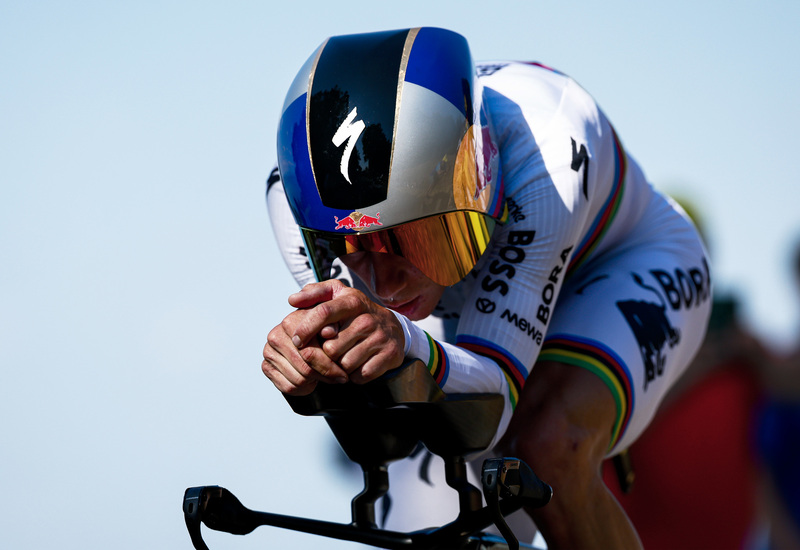
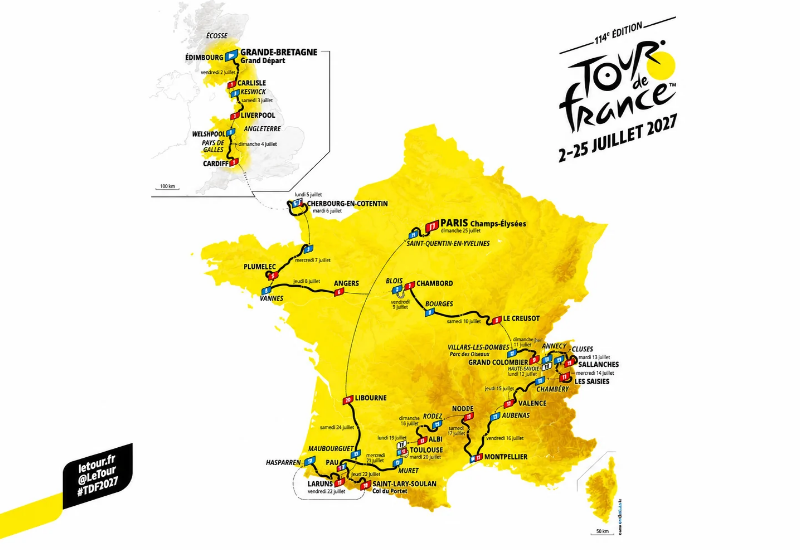
There hasn't been a Tour de France with so many individual time trials since Bradley Wiggins' triumph in 2012. The 71km time trial on the 2027 route tips the balance towards the best specialist in the peloton, four-time world champion Remco Evenepoel .
No route can truly be "anti-Pogačar," but this is the best the Belgian could ask for: only three summit finishes and almost all the toughest climbs concentrated in the final two-thirds of the race. Second in the 2026 Grande Boucle behind the Slovenian, Evenepoel will return in July aiming to repeat his feat, at least in the general classification.
Red Bull-Bora-Hansgrohe team principal Ralph Denk wasn't too enthusiastic: "A dream Tour for Remco? I see it a little differently, more nuanced," he told Het Laatste Nieuws at the presentation in Paris. He did, however, admit that, at least on paper, stages 7 and 16, two almost entirely flat time trials, should be a good fit. "Remco is currently the best time trialist in the world, so that's an aspect of the Tour we'll definitely take into account. Can he gain time on Pogačar, Vingegaard, Seixas, and company? In theory, yes."
The team's Chief of Sports, Zak Dempster , is of the same opinion: «The many kilometres of time trials will give an extra dimension and will make the fight for the yellow jersey more open and exciting» .
But how much can Evenepoel really gain on the Slovenian, returning to a time trial of over 70 km after 14 years?
What the numbers say
Evenepoel only made his Tour debut in 2024, so in the three editions he's contested against Pogačar, now a five-time winner and joint record holder, the two have faced each other in just five time trials in the Grand Tours . All of them were in the Tour, and the score is currently 3-2 in favor of the Belgian. Pogačar has won the two most challenging races: the one in Nice at the end of the 2024 Tour and the Peyragudes time trial in 2025.
Evenepoel has won the flattest stages: Gevrey-Chambertin in 2024, Caen in 2025 and Thonon-les-Bains in 2026. The margins, however, have never been huge: 12, 16 and 28 seconds .
The advantage is there, of course, as it should be on the very flat stage 7 to Chambord and on stage 16 to Toulouse. The latter features the incredibly steep Côte de Pech David (800 meters at 12%) in between. But we're far from the absolute dominance that Evenepoel exerts over his opponents, including Pogačar, outside of the Grand Tours.
Just think of the image of the Belgian overtaking the once-deemed immortal Slovenian in the time trial at the World Championships in Kigali 13 months ago: the symbol of a monopoly that has lasted for four consecutive rainbow jerseys. That day, the gap was not only evident in the overtaking, but also at the finish: 2:37 . In their careers, the two have met 12 times in individual time trials, and Evenepoel has won 10 of them. Their only two defeats have come on the mountainous courses of the Tour.
So why does the gap close so much at the Tour? When there's a climb, the balance clearly tilts toward Pogačar: for the Belgian Aero Bullet , the aerodynamic advantage matters less, because at lower speeds, air resistance weighs less and the power-to-weight ratio becomes crucial. But even on flatter courses, where Evenepoel has humiliated the likes of Filippo Ganna for years (finishing him by a whopping 57 seconds at the World Championships in Montreal), the Slovenian is much closer at the Tour.
The most likely answer is weight . Evenepoel admitted this year that he arrived at the Tour almost 4 kg under his weight during the Classics. He was in extraordinary condition: victory at Plateau de Solaison, second place at Alpe d'Huez, and the ability to stay with Pogačar much longer than in the past in the second and third weeks. For the World Time Trial Championships, however, he's working on a heavier weight, about 1-2 kg more, sacrificing some power-to-weight ratio to increase raw power, his preferred weapon.
Then there's another factor: no one in the peloton has the ability to repeat his performances over the three weeks like Pogačar , a six-time Grand Tour winner. His recovery makes him competitive every day, on nervous finishes, mountain stages, and time trials.
How much can you gain in 71 km?
The best comparison is the 28-second lead he held over Pogačar in this year's time trial, which was just 26.1 km long. Based on the average speeds that day (48.85 km/h for Evenepoel versus 47.751 km/h for the Slovenian), in a perfect world the Belgian would cover the 71 km with a 1:05 advantage . Not exactly a blast, but a time trial, with its curves, ups and downs, and accelerations, is anything but a perfect world.
Evenepoel's advantage could grow with the distance, given that he has the best aerodynamic position in the peloton. This is especially true if the flattest stage, about 38 kilometers long, increases his lead kilometer after kilometer. However, the steep climb on stage 16, even though it's only 800 meters long, greatly favors Pogačar and evens out the competition.
The conclusion is clear: Evenepoel can't rely solely on his best weapon to beat the current benchmark. He'll have to beat him, or at least match him, in the high mountains to stay within range of the stages he'll almost certainly win.
The stage factor 9
The Belgian newspaper also asked Red Bull management about the potential benefit of the arrival of the first mountain stage, Stage 9. Evenepoel only made significant progress on the climbs in July, after a difficult first week. "It could be an advantage," Denk replied. "On the other hand, if you're focusing everything on the general classification, and we always want to do that with this team, you have to be careful even in the first ten days and monitor the situation."
Of the 6:26 delay from Pogačar to Paris, Evenepoel lost almost three minutes on stage 6, the first real high-mountain day, towards Gavarnie-Gèdre. Losing just over three minutes in the remaining 15 stages was a huge step forward and could further help the Belgian phenomenon, in his second year with Red Bull. But he'll need to stay close to Pogačar on stages like the incredibly tough 18th towards the Col du Portet, as only Jonas Vingegaard has managed since 2020, if he truly wants to dream of the yellow jersey.