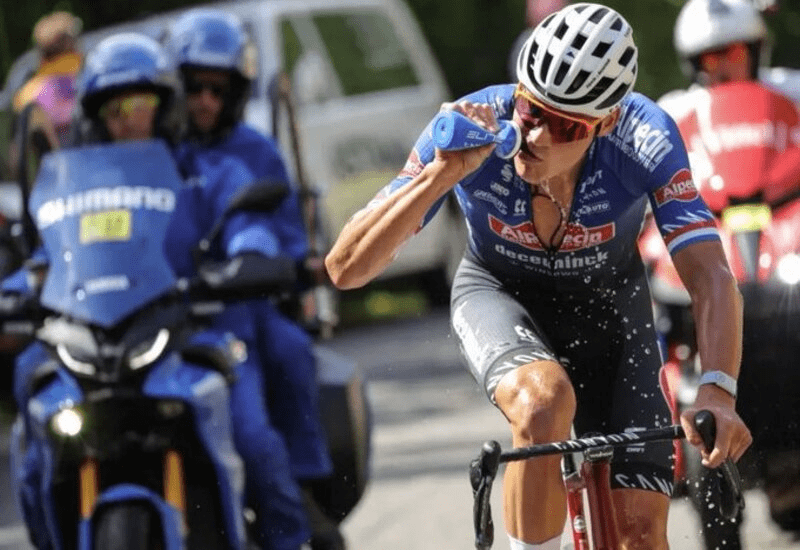
The 2026 Tour de France riders already suffered greatly from the heat during stage 3, crossing the Pyrenees from Granollers to Les Angles. But worse could be yet to come: for Tuesday's stage 4, from Carcassonne to Foix in southwest France, weather forecasts predict temperatures could reach 37°C upon arrival in Foix.
Our correspondents witnessed firsthand the fatigue of the runners at the finish line in Les Angles: salt stains on their bodies from excessive sweating, dull looks, heavy legs. A picture that speaks louder than words.
Tom Pidcock (Pinarello-Q36.5) didn't mince his words: "I don't think I've ever ridden such a tough race in this heat. It was ridiculous. It was like a war zone. I think as a group we went through about 10,000 bottles today. By the end I had nothing left, I was literally cooked."
The African heat had already hit France and much of Europe in the weeks leading up to the Tour's start, and now it appears to have returned in force in the southwest. The French government has informed local prefects of the possibility of canceling stages in the event of a red weather alert to protect spectators, law enforcement, and emergency services. An orange alert has currently been confirmed for several departments crossed by stage 4, but no changes or cancellations are expected.
Matteo Trentin , always attentive to the safety of his riders, declared immediately: "If I weren't a professional, I wouldn't even get on my bike in this heat. It's unhealthy. We haven't been told anything yet; we're addressing the problem day by day. Unfortunately, it's difficult to change routes or start times so close to each stage."
Trentin added a broader reflection: "It's always been hot at the Tour, but not this much. It barely cools down at night, and it's hot even in the early morning. Stage start times have gradually shifted toward noon or 1 p.m., and that's not a smart move."
The UCI has a Protocol for Extreme Weather Conditions that provides for gradual measures, from increased hydration during the race to race cancellation in extreme cases. The protocol is based on the WBGT (Wet Bulb Globe Temperature) index, which combines air temperature, humidity, solar radiation, and wind speed to assess the actual impact on the human body. A WBGT temperature between 23°C and 27.9°C is considered an orange zone (moderate to high risk), while temperatures above 28°C enter the red zone, representing high risk.
Teams have adopted increasingly sophisticated countermeasures: cooling vests, ice socks, ice cubes around the neck, and ice slushes to lower body temperature. Many teams provide ice tubs near the finish line buses, while runners splash themselves with cold water during the race.
Tour organizers, however, are reluctant to change or cancel stages. Race director Christian Prudhomme stated before the start: "We are ready to adapt anywhere, anytime. We will provide more ice to the teams, we will be able to authorize more frequent refreshments, and we have already added a third motorbike to distribute more water bottles during the stages."