Cycling
Giro d'Italia 2027, the route is revealed!
The Mortirolo, Gavia, and Zoncolan passes are present. Departure from Trieste and arrival in Rome.
R
Written by
Editorial Team
6 min read

The Mortirolo, Gavia, and Zoncolan passes are present. Departure from Trieste and arrival in Rome.

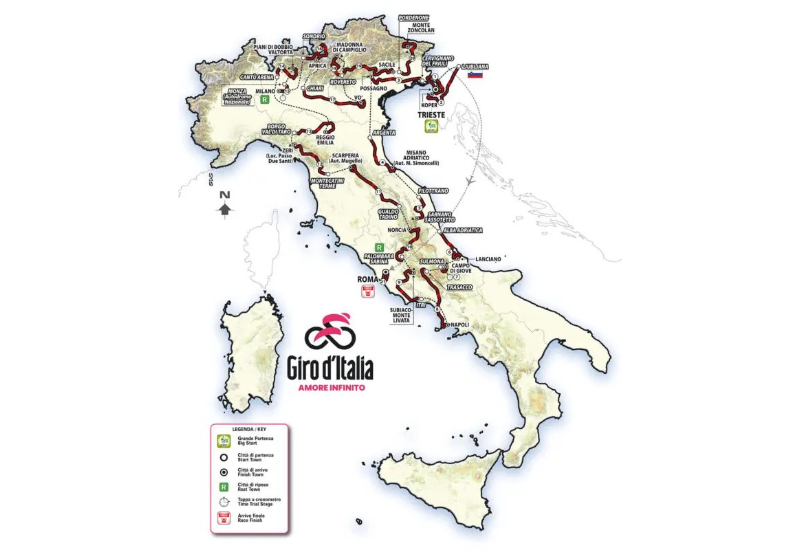
The 2027 Giro d'Italia has its own face, and it's a climber's paradise . At the presentation in Rome, RCS Sport unveiled the route of the 110th edition of the Giro d'Italia: 21 stages, 3,418 km , and 50,250 meters of elevation gain from Trieste, near the Slovenian border, to the capital. The three highlights are already legendary: the Mortirolo Pass (twice), the Gavia Pass , and Monte Zoncolan .
After two years of starts abroad, the Grande Partenza returns to Italy: it begins on Saturday, May 8th , in Trieste, with a foray into Slovenia as early as the second stage. There will be two rest days, and the grand finale is set for Sunday, May 30th . The plan is clear: the race will be decided entirely in the final week, with a route concentrated primarily in Northern Italy.
There are seven uphill finishes , between the Apennines and the Alps, and two time trials: a 19.6km uphill time trial towards Campo di Giove and a 37.3km flat time trial between the Monza racetrack and Milan. Ten years after Tom Dumoulin's first Grand Tour, the route opens the door to a time trialist, although the final mountains will only reward the truly accomplished riders for the pink jersey.
Regarding names, RCS is hoping for Remco Evenepoel as a key player. Reigning champion Jonas Vingegaard is unlikely to return, while Tadej Pogačar, winner in 2024, seems oriented towards the Tour de France and Vuelta a España. Primož Roglič, winner in 2023, hasn't yet signed a new team for 2027. Evenepoel's team might not be able to compete in the Giro and Tour, so the start list is still being finalized.
Not just the general classification: pure sprinters will have six to eight chances, but many stages feature steep climbs or final climbs that will favor attackers and breakaway hunters. This is the first Giro d'Italia designed after race director Mauro Vegni's withdrawal, but the result remains a classic: a bit of everything for everyone.
First week: puncheur on display and first shocks
Stage 1 in Trieste (172 km) will award the first pink jersey with three short climbs in the final 30 km: terrain for punchers and stamina sprinters, while the top GC riders will be trying not to waste time. Stage 2 , from Ljubljana to Koper (166 km), is run entirely in Slovenia with an undulating profile. Stage 3 to Possagno (163 km) has a slightly uphill finish, again suited to punchers.
After the liaison, stage 4 (Argenta-Misano Adriatico, 151 km) finishes at the Marco Simoncelli racetrack and is the first guaranteed opportunity for sprinters. Stage 5 leads to the first uphill finish, Sarnano-Sassotetto (13.1 km at 7.4%): according to the organizers, it's rated three stars for difficulty, more of a test than a decisive stage.
Stage 6 , towards Lanciano (148 km), with rolling roads and a treacherous finish, could benefit the breakaway. The next day brings the first real watershed: stage 7 is the Sulmona-Campo di Giove time trial (19.6 km, with a 12.5 km climb). It's the Giro's first time trial since 2023, but with an average gradient of 4.4%, it's much less ferocious than the one won by Roglič.
Stage 8 (Trasacco-Naples, 219 km) returns to the Campania capital and, with several steep climbs in the final 30 km, appears more for punchers than sprinters. The first week concludes with stage 9 (Itri-Subiaco/Monte Livata, 180 km), nearly 3,000 meters of elevation gain and the finish at Monte Livata (13.9 km at 6.9%), with the steepest gradients concentrated in the first 4 km. The climb is new to the Giro, but was climbed in last year's U23 Giro, with Lorenzo Finn taking a solo victory.
Second week: the Monza time trial prepares for the finale
After the first rest, stages 10 and 11 offer opportunities for breakaways: the first has two climbs in the final 30 km and a long descent towards Norcia, the second seems to be for sprinters, but a short climb 28 km from the finish in Scarperia (Mugello racetrack) could change the cards.
Stage 12 brings the overall standings back to the forefront with the finish at Passo Due Santi (8.7 km at 8.3%, with the final 2.4 km at over 11%). Stage 13 to Reggio Emilia is almost certainly for the sprinters. Then, stage 14 is the toughest yet: nearly 5,000 meters of elevation gain to Piani di Bobbio/Valtorta , with four shorter climbs and a final 10.1 km climb at 9%. Anyone who doesn't already have a solid lead will have one of their best chances to take control here.
The second week concludes with stage 15 , the flat time trial from Monza to Milan (37.3 km). If Evenepoel is absent, it could become a testing ground for specialists like Filippo Ganna, while the general classification riders will need to have recovered from the previous day's exertions.
Week 3: Mortirolo, Gavia, and Zoncolan decide the squad
As is tradition, the Giro concentrates its best efforts in the final week, without a smooth restart after the second rest period. The queen stage, Stage 16 , from Sondrio to Aprica, takes place on Tuesday, May 25: 192 km, 5,700 meters of elevation gain, and a thrilling sequence. First, the Mortirolo (12.8 km at 10.1%), then the return to the Gavia Pass (16.5 km at an average gradient of 8%, reaching an altitude of 2,600 meters), a first since 2014, followed by a second pass over the Mortirolo and the final climb to Aprica. It could be one of the toughest stages of the entire season, capable of turning the race around.
If the sprinters have survived this far, stage 17 to Vo' could offer them a chance, but two hills in the final 20 km make a breakaway more likely. Stage 18 , with 4,450 meters of elevation gain and finishing in Madonna di Campiglio , is another uphill finish: the final climb is gentler (average 5.7%) and could favor a breakaway while the big names focus on the Zoncolan. Stage 19 to Sacile looks like a sprinter's affair, but the initial climbs after Rovereto leave room for a strong breakaway.
The verdict comes with stage 20 , Pordenone- Monte Zoncolan (180 km): 10.1 km at an average gradient of 11.9% and 3,600 meters of elevation gain concentrated in the final section. The last time the Giro tackled it, in 2021, the finish was shrouded in fog and cold, with Lorenzo Fortunato winning. Now someone will be able to join him, Chris Froome, and Michael Rogers in the roll of honor. Whoever is in pink at the summit will almost certainly be the winner: stage 21 to Rome (131 km) is the usual circuit for sprinters.
Sports journalist and cycling enthusiast, following professional cycling for over 10 years. Collaborates with FantaCycling to bring you the best analysis and news from the world of cycling.
The Mortirolo, Gavia, and Zoncolan passes are present. Departure from Trieste and arrival in Rome.
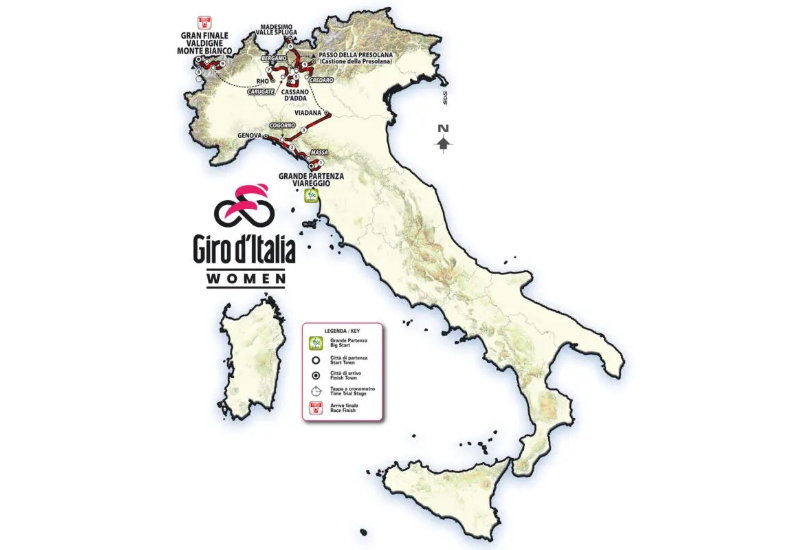
Discover the route of the Giro d'Italia Women 2027: 9 stages, 1,132 km, 17,450 meters of elevation gain, decisive climbs, and a final time trial.
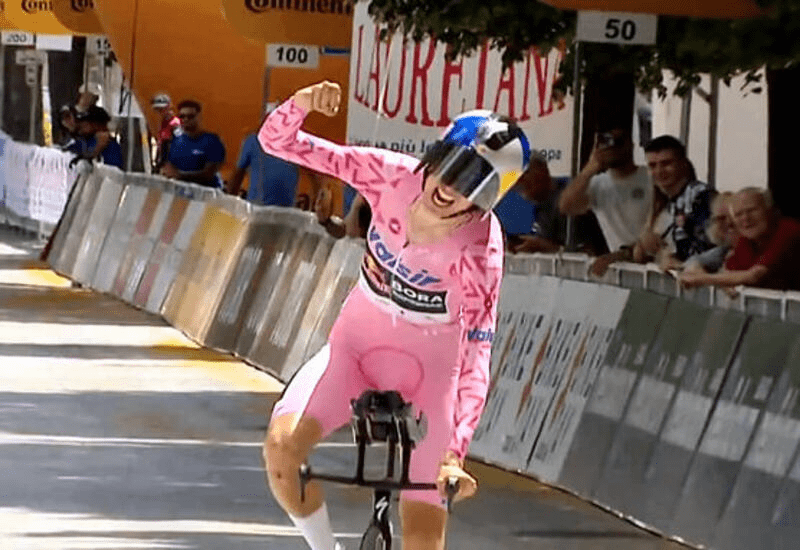
After a dominant season in the Under 23s, Lorenzo Finn moves to Red Bull-Bora-Hansgrohe in 2027
The Frenchman, stage winner at the 2023 Tour de France, will also be out of the peloton in 2027 due to a mysterious illness that has cancelled out his season.