Cycling
Disc brakes, from "hot knife blades" to an indispensable innovation
Ten years after the introduction of the much-debated brake, here are the pros and cons.
R
Written by
Editorial Team
8 min read

Ten years after the introduction of the much-debated brake, here are the pros and cons.

Imagine for a moment Tadej Pogačar starting the 2026 Tour de France on a bike equipped with rim brakes. It would be world news, enough to bring down every cycling forum on the internet. Yet, just a few years ago, the debate over disc brakes was still heated and heated.
Curiously, Pogačar was among the last diehards in the peloton to stick with rim brakes, along with Ineos Grenadiers , well after most teams had switched to disc brakes. A valuable benchmark for measuring the last gasps of a technology that seemed timeless.
Ten years have passed since the UCI granted a trial period for the use of disc brakes in the professional peloton, and today these powerful braking systems have become standard equipment. But the road to this point has been an uphill battle, also paving the way for other technologies that were initially opposed.
Cyclingnews reconstructed this story by speaking with riders, mechanics, and product managers who experienced this revolution firsthand, and how disc brakes changed racing dynamics forever.
Carbon wheels and the heat problem
Even before the UCI's decision, another innovation was generating excitement and headaches: carbon rims. Lightweight and stiff, they presented a serious problem: how to manage the heat generated by contact with the braking pads at high speed, which risked causing delamination.
"Everyone was looking for lighter, more aerodynamic rims, but that meant switching to carbon," says Dave Lawrence, Road and Gravel Product Manager at Shimano. "We'd heard stories of rainy stages at the Tour where new brake pads wouldn't make it to the finish. That's when the idea was born: disc brakes could solve all of this."
Let's not forget that people still raced with tubular tires: the heat from the skates could soften the glue, increasing the risk of the tire separating from the rim. A sea of potential benefits strewn with dangerous icebergs.
As SRAM Road Product Manager Dan Stefiuk points out: "Frame design, materials, and wheel technology evolved exponentially 10-15 years ago, while braking was still archaic, based on the hope that by pressing a piece of rubber against aluminum or carbon you would be able to brake predictably."
The solution already existed in the mountain bike world. "People were coming from other disciplines asking why disc brakes weren't used on the road," Lawrence explains. "It wasn't a one-off moment, but many small things that built momentum."
Knives, machetes and rotating blades of death
But momentum can be derailed if end users disagree. As soon as the UCI authorized disc brakes, the first major controversy erupted.
At the 2016 Paris-Roubaix, Francisco Ventoso suffered a serious leg injury in a crash, claiming he cut himself on a brake disc while trying to maintain his balance. Although the exact cause of the injury was never fully clarified, Ventoso's reaction made headlines around the world.
"Disc brakes should never have been introduced to the peloton, at least not as we know them now," Ventoso wrote in an open letter, later calling them "giant knives" and "machetes." These words may have been exaggerated, but they revealed a deep mistrust of a technology imposed without consensus. The incident led the UCI to suspend the trial period.
The following year, at the 2017 Abu Dhabi Tour, Team Sky's Owain Doull crashed one kilometer from the finish line, claiming he had been injured by the disc brakes of Marcel Kittel , the only rider in the race using disc brakes. Subsequent videos, however, cast serious doubt on the actual cause of the injury.
The era of "mixed brakes"
Perhaps it was precisely this uncertainty that kept the group grounded. "There was initial skepticism within the group, along with concerns about safety," says Ruth Edwards (née Winder), an Olympian and a key figure in the women's peloton during the disc brake era. "We didn't know if you could actually hurt yourself with the rotor in a crash, and there was also the difference in braking speeds that could cause accidents."
American cyclist Peter Stetina agrees: "Suddenly, there were two braking speeds in the peloton between the teams sponsored by disc brakes and those with rim brakes. This became the excuse for some crashes in that first 'mixed brake' season. I remember one crash with a deep laceration, and everyone blamed those 'hot knife blades on our wheels'."
Disc brakes changed not only the braking ability of individual riders, but also group dynamics: some could brake much later into corners than others, completely altering trajectories and reaction times in the group.
From a manufacturing standpoint, brands had to adapt to new braking forces and frame designs. "Some manufacturers had invested a lot of time developing rim-brake frames," Lawrence explains, "and if you were just coming out with a rim-brake frame, you might not have the time or money to develop a disc-brake one in the same timeframe."
Variations in caliper mounting points further complicated matters. "Some frames were flat versus post mount, QR versus thru-axle, 130 versus 142mm, which created a lot of inconsistencies," Stefiuk adds. "The ergonomics were new, and the levers were larger than today. But there's no doubt that disc brakes performed better, more consistently, and were safer, benefiting both seasoned pros and new riders."
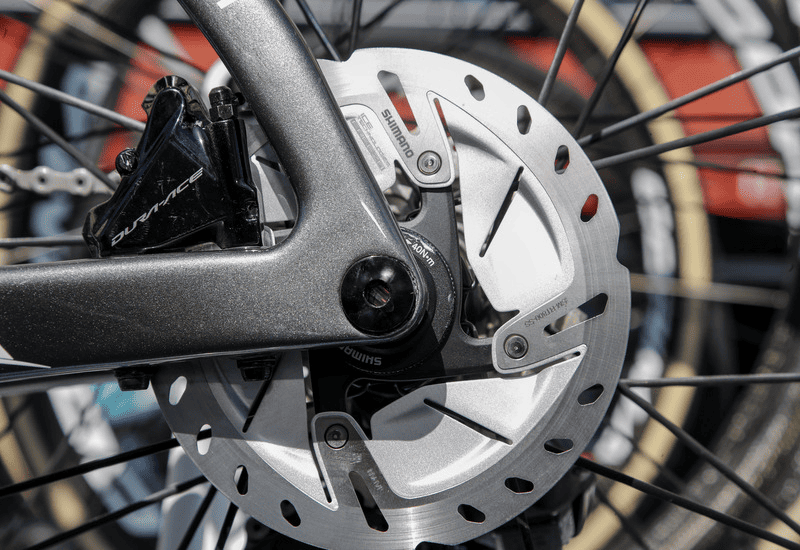
And those "rotating blades of death"? Stefiuk says the industry took a proactive approach, rounding the rotor edges to mitigate the risk of lacerations.
Stetina recalls another problem typical of the early days: rotor slippage. The gap between pads and rotors could vary for a variety of reasons, from heat from the brake fluid to imprecise caliper adjustment. It was an annoying, audible reminder of a technology that wasn't yet fully developed.
"There was more pad friction than we wanted in the first generations," Lawrence confirms. "We've learned a lot and improved the product. Today we have about 10% more pad space than the first generations. Our first rotors deformed more under heavy braking, causing that annoying clicking sound on long descents. Now that's all been fixed."
Frames have also evolved. While changes like wider thru-axles were indeed necessary, many initial compromises proved excessive. "At the time, most production had moved to Taiwan, and designers had to learn to accommodate disc brakes," Stefiuk explains. "Some early frames loosened the geometry too much to accommodate the 142mm OLD, making the chainstays excessively long. In an athlete's mind, not only are you giving me disc brakes and a heavier frame, but now I also have a frame that doesn't feel responsive and doesn't allow me to ride the way I want."
Today, when riding any modern road bike, that responsiveness has returned in abundance. The learning curve wasn't just for the riders, but also for the manufacturers, who found a way to leave the compromises behind.
The silent heroes who sighed at night
It wasn't just the riders who were wary of this new technology. Behind every professional rider was a mechanic who stayed up late cleaning, adjusting, and preparing the bikes. Disc brakes also profoundly changed the mechanics' work processes.
"Just like the veteran racers, there were mechanics who predated the Indurain era when disc brakes were introduced," Stefiuk says. "Some embraced the new technology, appreciating the hydraulics and no longer having to change contaminated cables every night, while others continued to smoke cigarettes and clean their drivetrains with a brush and a can of diesel fuel."
Mechanics who had learned the trade when Merckx was still young now found themselves having to learn, often in real time, a technology that was potentially dangerous if handled incorrectly.
Lawrence recalls the early training sessions: "It's funny, for the more traditional mechanics, it was one thing after another. First the electronic shifting, then the disc brakes. You had to teach these traditional mechanics how to bleed the brakes. I was there in the early days. You'd talk to the cutting-edge technical directors, and they were the ones who said, 'Oh no, I have to explain all this to my five Belgian mechanics!'"
Both Stefiuk and Lawrence agree: the mechanics are the silent heroes of the group, and despite initial grumbling, they rose to the challenge, ultimately turning disc brakes into an everyday advantage.
Forget that it had ever been a controversy
Perhaps it was simply a surrender to the inevitable, or perhaps real improvements and concrete results convinced everyone. In any case, today disc brakes dominate the peloton and rim brakes are a closed chapter in cycling history.
"Acceptance, from my perspective, was simply mandatory," says Edwards. "It was what was on the new bikes at the meet. You went to practice and got used to it. Disc brakes are fantastic. I have much more confidence in my braking ability now. I would never want to be on rim brakes in an all-disc group. Descending feels different; it's all about learning your speed and what the equipment can do."
Stetina notes that from a logistical standpoint, improvements in wheel changes made a huge difference: "Technology improved, thru-axle designs advanced, rotor rub became less frequent, and it all happened relatively quickly. But in the minds of many riders, it never really became accepted until a big mountain finish was won on a disc bike. After that, there was no longer any valid excuse. I think it was Pogi or [Egan] Bernal who won a five-star stage somewhere, and then we all thought, 'OK, this is here to stay.'"
Maybe that's all it really takes: a clear demonstration of superior performance. Men advancing engineering achievements. Isn't that always the way it works?
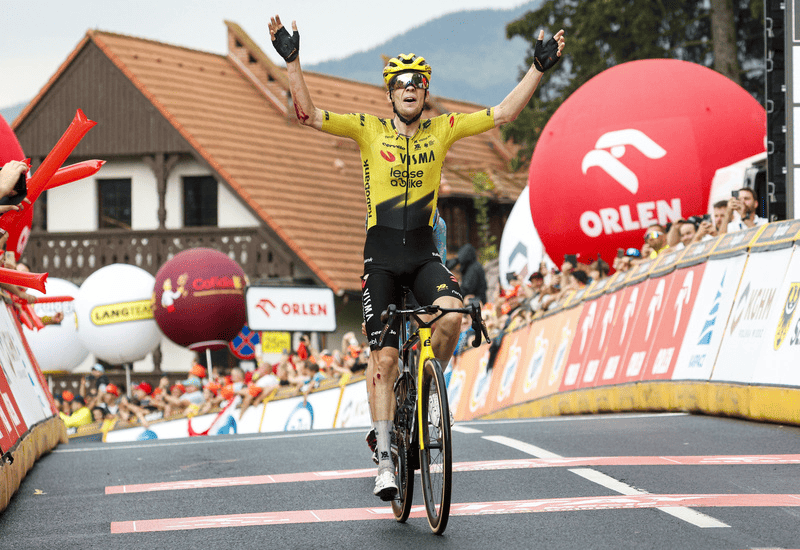
Photo: Sprint Cycling Agency
Sports journalist and cycling enthusiast, following professional cycling for over 10 years. Collaborates with FantaCycling to bring you the best analysis and news from the world of cycling.
Ten years after the introduction of the much-debated brake, here are the pros and cons.

Sports Director Cherie Pridham defends the team's three-pronged approach after stage 6, while Longo Borghini, Włodarczyk and Blasi occupy three positions in the overall top 10
From a marriage proposal to a mountain bike ascent at 10 years old: here's why the Giant of Provence is making the entire Tour de France Femmes group dream.
The Mauritian rider from AG Insurance-Soudal outclasses Kerbaol and Pieterse at the finish line in Tournon-sur-Rhône, in a thrilling stage decided by an elite group.